Recent data on Lithuanians’ attitudes towards the internet and Artificial Intelligence (AI) reveals a mixed perspective. While many people view these technologies as beneficial and helpful in everyday life, there is also a significant level of caution when it comes to situations where technologies take over functions or tasks typically performed by humans.
According to the professor, the biggest paradox is that white-collar positions, such as administrators, programmers and accountants, are at the greatest risk of losing their jobs to AI, as these functions are easy to translate into algorithms. On the contrary, jobs requiring complex sensory and motor skills remain resistant to robotisation for now, according to Keturakis.
Lithuanian internet users are cautious
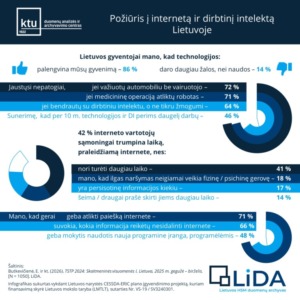
The data in the infographic shows that 42% of internet users are consciously reducing their screen time. The main reasons are the wish to have more free time (41%), the negative impact of prolonged scrolling on their personal well-being (18%), information overload (17%) and family and friends’ requests to spend more time with them (17%).
According to the associate professor, it is crucial to keep strengthening technological confidence and foster digital literacy skills, so that society will accept innovations not only boldly but also critically and responsibly.
A huge part of society believes having necessary digital skills – browsing on the internet (71%), knowing what personal information should not be posted on the internet (89%), and feeling confident in their abilities to learn using new software (48%). However, digital skills do not necessarily equal confidence in technology.
The use of technology is a matter of national security
The associate professor Jurkevičienė notes that the project RECONECT (S-VIS-23-14), funded by the Research Council of Lithuania and carried out by her and her team, reveals the broader context surrounding technological security.
Today, the impact of technology and AI extends beyond personal benefits or work efficiency. Information flows and AI tools can be utilised for manipulation, the spread of disinformation, shaping public opinion, or even imposing geopolitical pressure.
Therefore, the ability to critically assess information, leverage AI and technology and identify potential risks has become not only a personal challenge but also a matter of national security, significantly impacting societal resilience against geopolitical threats.