Global events we have witnessed recently reveal the cascading nature of crises and disasters – they trigger the interconnected disruptions in often unrelated systems, such as a volcanic eruption in Iceland in 2010, causing interferences in European air travel, which then resulted in economic and logistical challenges in various countries. Or the well-known COVID-19, which impacted education systems and even caused an increase of domestic violence in some regions due to the restricted access to support services during lockdown.
As our social, economic, technological, and environmental systems are so intertwined, even small local disruptions can quickly spread into wider challenges. How does society respond and adapt to the today’s challenges caused by cascading crises? How can can society prevent, prepare for and be resilient to such events?
Cascading crises in the Baltic states
Baltic states also have witnessed an impact of cascading crises. When the war in Ukraine started in 2022, Europe experienced an energy crisis, which was a “shock therapy” for the EU energy transition.
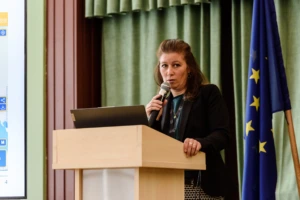
“The energy crisis has hit the Baltic states particularly hard. At some point in the summer of 2022, the energy prices in the Baltic states were 10 times higher than the European average. Consequently, Lithuania burned fuel oil for heating in the 2022-2023 season, particularly as a temporary emergency measure to combat skyrocketing energy prices, which had effects on public health”, – says Prof. Dr. Aistė Balžekienė, researcher in KTU Faculty of Social Sciences, Arts and Humanities, and the chair of scientific and organizational committee of he NEEDS 2026 Conference.
In Lithuania and the wider Baltic region, cascading crises are shaped by hybrid threats such as cyberattacks, disinformation, hostile influence operations, instrumentalized migration, disruption of essential services, critical infrastructure sabotage, economic pressure, and attempts to exploit social polarization.
Therefore, resilience in the Baltic states cannot be only reactive or sector-specific; it must be built into national security, crisis governance, civil defence, and societal preparedness.
Lithuania’s move toward total defence and comprehensive crisis management shows how frontline democracies are trying to respond to a polycrisis environment by involving not only state institutions, but also municipalities, NGOs, local communities, volunteers, and individual citizens.
One of the partners of NEEDS conference was Horizon Europe project “DeCrises”, that focuses on the role of social innovations in the just twin (energy and digital) transition in Baltic sea region. Social innovation can play an important role in strengthening societal resilience during crises at local community or regional levels.
Disaster related challenges from a European perspective
The conference focused on multidisciplinary approach, which also correlates with NEEDS network’s values. It was grounded in the social sciences, but brought together ideas and research from many different fields, all looking at disaster-related challenges from a European perspective.
Disaster-related challenges in Europe are increasingly shaped by climate extremes, multi-hazard events, and cascading impacts on critical infrastructure. As the climate warms, extreme weather events are expected to become more frequent and severe, creating risks that do not remain isolated but spread across interconnected systems such as energy, water, transport, and telecommunications.
Traditional disaster risk management often underestimates these risks because it may not fully account for how one disruption can trigger another across different sectors and time scales. This makes multi-hazard early warning systems and cross-sector preparedness essential for Europe’s future resilience.
From Early Warnings to Prepared Action
Preparedness for crises depends not only on having accurate early-warning systems and resilient infrastructure, but also on ensuring that institutions know how to act on the information they receive.
These exercises help identify weaknesses in existing systems, improve cooperation between local, regional, and national actors, and strengthen both strategic and operational readiness for future drought events.
During the conference several crises simulation scenarios from different international teams were presented. One of the scenarios was prepared implementing research project “Socio-spatial determinants of societal vulnerability and resilience to crises and strengthening the crisis response potential of communities (SERENITY), funded by Research council of Lithuania and implemented at KTU. It had a strong emphasis on cascading crises and risk communication and echoed in a need to focus on prevention and anticipation.
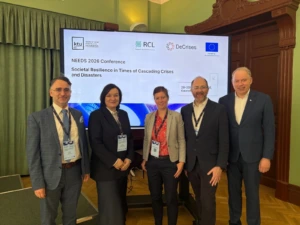
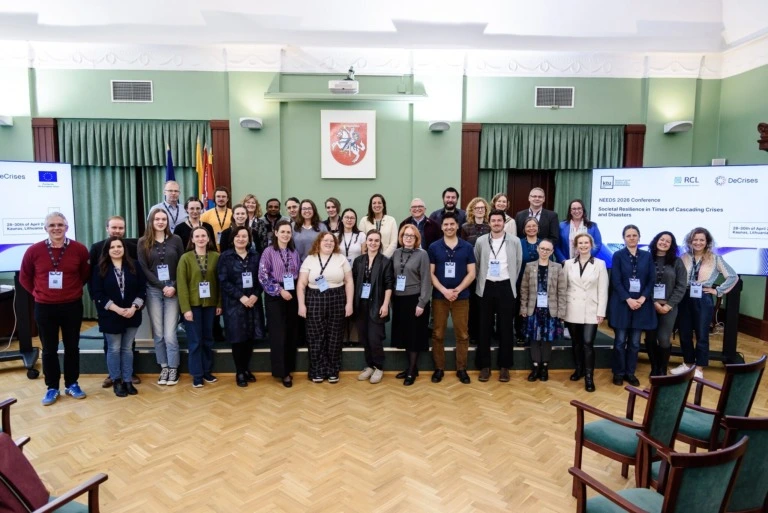
The conference attracted more than 130 participants from more than 20 countries, to share scientific and practical insights and to share experiences that can be transferrable over cultural and regional contexts for a safer future.
Conference abstract book can be found here.