Skip to content
Orange background with three connected white building blocks and the text “9 Industry, Innovation and Infrastructure.” Represents the development of resilient infrastructure and sustainable industrialization.
Magenta background with a white icon of four arrows pointing outward from an equals sign, and the text “10 Reduced Inequalities.” Represents the goal of reducing inequality within and among countries.
Navy background with five interlinked white circles forming a flower-like shape, and the text “17 Partnerships for the Goals.” Illustrates the goal of strengthening global partnerships to support sustainable development.

KTU researcher: tracking inequity in the space economy

Research | 2026-03-18

Dr. Florian Caspar Rabitz is a Chief Researcher in the KTU Faculty of Social Sciences, Arts and Humanities.

Outer space is big business. Technological innovation has driven launch costs down so far that space operations are becoming affordable to an increasing range of commercial actors and private individuals. Growing numbers of private companies are landing (and crashing) vehicles on the Moon. Space mining, such as for Rare Earth deposits in asteroids, or for lunar ice, promises big paydays while possibly extending the reach of humanity beyond the Moon and further into the solar system. And a planned hotel on the surface of the Moon is taking space tourism to the next level.

Satellite systems are by far the most important component of the space economy. Satellites are indispensable for global telecommunications, navigation, and logistics. They provide imaging services for everything from tracking Arctic ice loss over the detection of forest fires up to the identification of promising archaeological dig sites.

They are also critical elements of modern military operations, as the controversies over the role of Starlink satellites in the Russian-Ukrainian war show. If space is the future, satellites are a big part of it.

But whose future is it, really? In our newest article, developed as part of the LMT-funded research project “Transnationalization of Outer Space”, we analyze organizational partnerships in the global satellite industry.

Rabitz_KTU
Florian Rabitz, chief researcher at the KTU Civil Society and Sustainability research group.

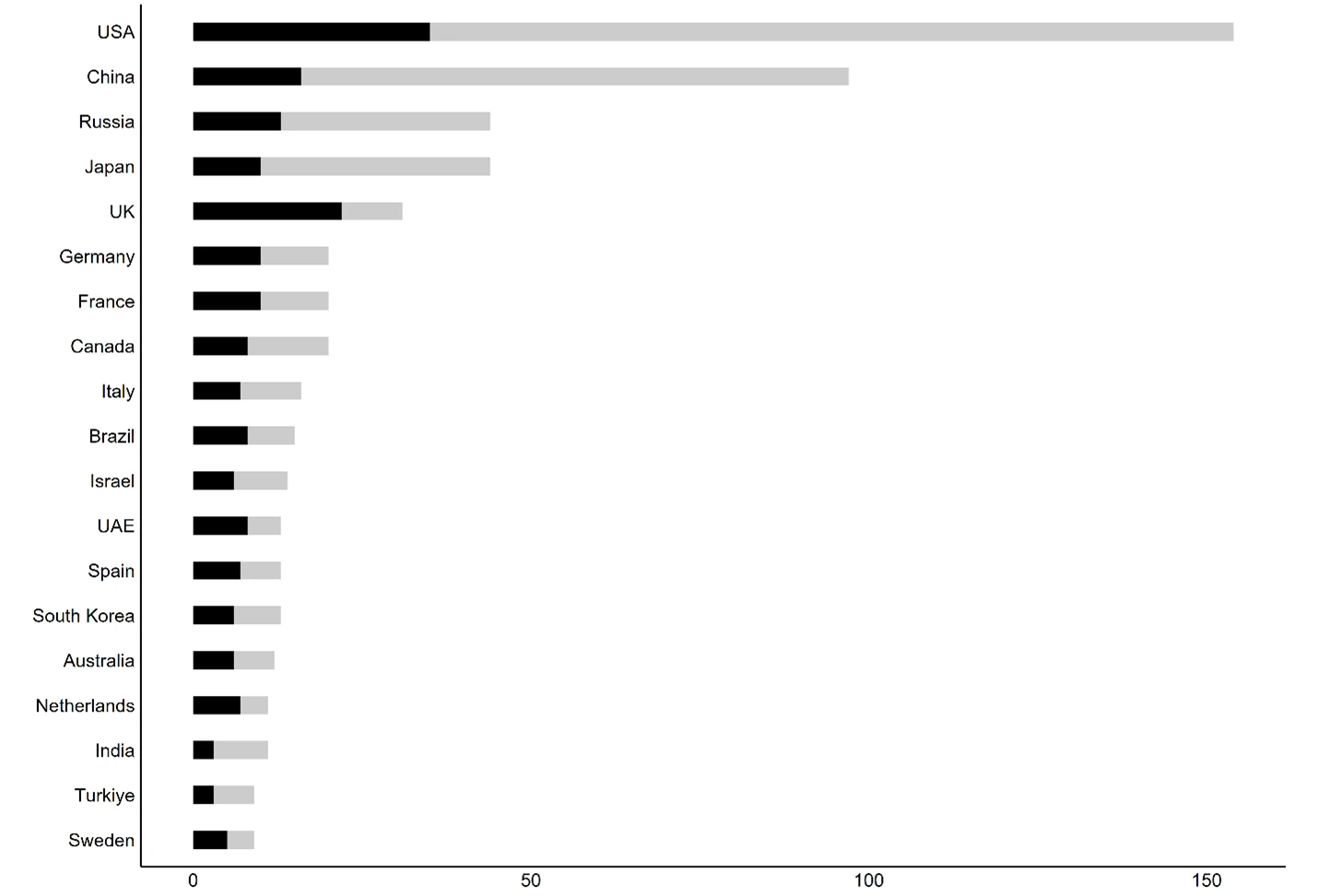
Tracking close to 4000 partnerships between hundreds of public and private organizations over two decades, our results show that the global satellite industry is dominated by a handful of companies from a handful of countries. Most of these are industrialized countries, with the USA in the pole position, but also including Japan, the UK, Germany, and France. Russia remains an important player in the industry due to the legacies of the Soviet space program.

China is the only new kid on the block: Primarily as a result of US export controls on satellite technology, China has build up impressive domestic industrial capacities as part of its now world-leading space program. Beyond China and (to a lesser extent) Brazil, India, and Turkiye the role of developing countries and emerging economies in the global satellite industry remains marginal.

Industrial partnerships by country. Domestic partnerships in grey, international partnerships in black.

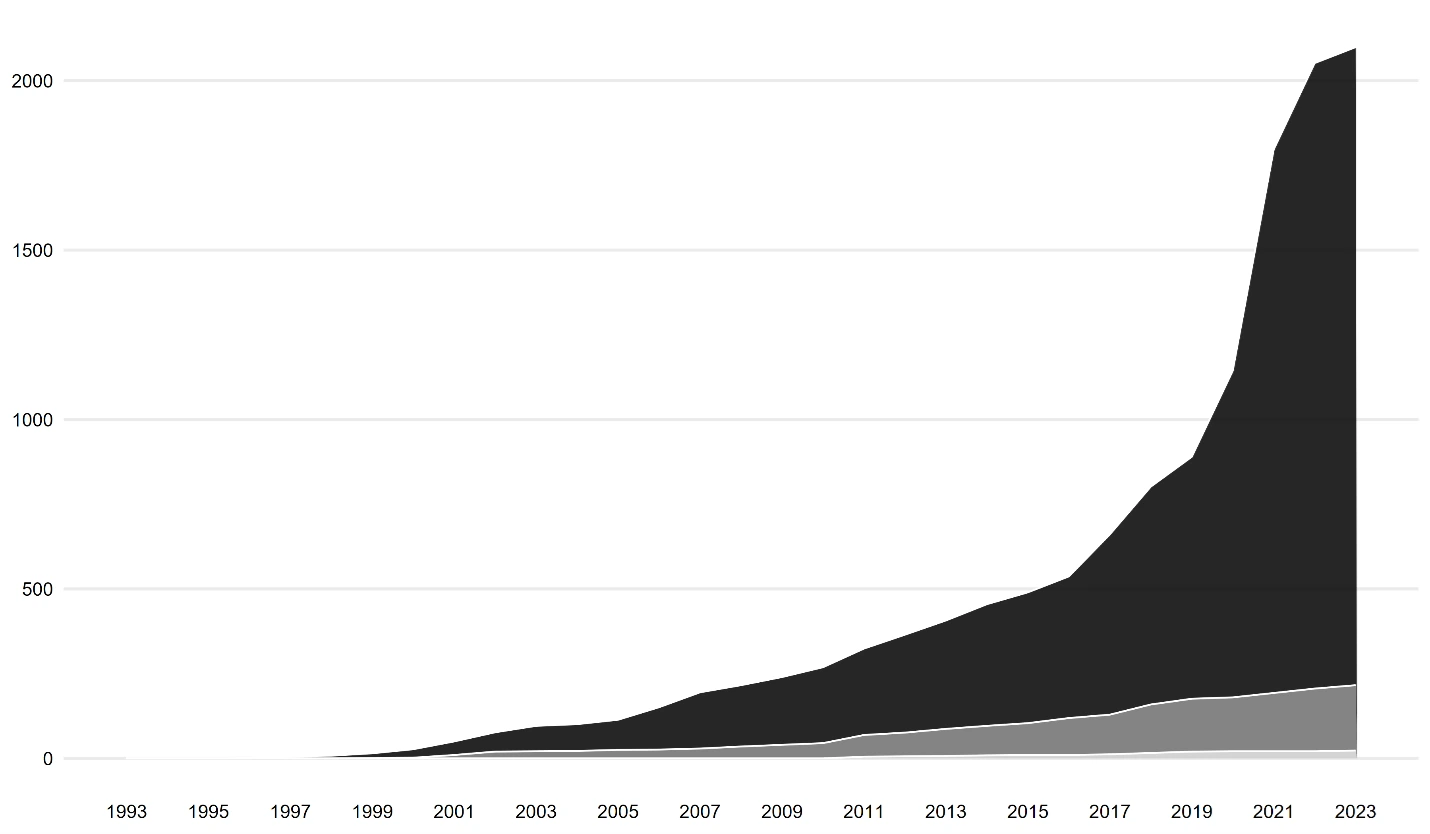
This is not just the case for industrial capacities, but also for industrial collaboration: An overwhelming share of industry partnerships take place within and between the countries of the Global North, with limited room for North-South cooperation, and South-South cooperation being virtually absent. For developing countries, this poses the well-known problem of limited access to technology produced, owned, and controlled by governments and companies situated in the Global North. It also excludes them from spin-off benefits such as knowledge transfer, innovation, or employment growth in high-tech sectors.

Inter-organizational industry partnerships per year. North-North cooperation in black; North-South cooperation in dark grey; South-South cooperation in light grey.

The centrality of satellites for global sustainability, particularly in developing countries, makes this problem especially acute. Developing countries are more exposed to natural disaster risk than industrialized countries and are thus in need of robust early-warning capacities. Satellites are the only feasible technological option for ensuring internet access, and thus also access to information and education, in remote rural regions. Communications, logistics, and environmental monitoring are all key areas where greater technological capacities in developing countries would improve global equity.


KTU researcher Inga Popovaite in MDRS

The way things stand, there is an urgent need to improve technology transfer and access for actors that are, so far, largely excluded from the space economy. While technology transfer is widely acknowledged as a key component of global sustainable development at the highest political levels, the experience with other issue areas suggests that the political and economic barriers for greater equity in the satellite sector are likely formidable.

Improved data-sharing arrangements may accordingly offer an alternative way forward: Even without having direct operational control over satellite systems, developing countries can derive benefits if they have unburdened access to the data generated by these systems. This will not be enough to remedy cases where satellites are simply not being made available for purposes aligned with sustainable development in the Global South.

Open access models will also have to confront the trend towards data access restrictions brought about by the interests of commercial players. At best, they may thus offer a temporary and limited solution for ensuring that the benefits of the space economy are being distributed with a modicum of fairness. But in the long run, questions of global industrial structure will need to be on the table.

KTU researcher Vidas Vilčinskas

Florian Rabitz, Inga Popovaitė and Vidas Vilčinskas are researchers at KTU Faculty of Social Sciences, Arts and Humanities working on the project “The Transnationalization of Outer Space”, funded by the Research Council of Lithuania (project no. P-MIP-23-234).